Friday, September 26, 2008

Google Calculator cheat sheet

I just found an awesome site describing some of the features in Google while looking for info on Google Calculator:  Google Guide

My first find was the Quick Reference: Google Calculator (Cheat Sheet).

I like this tip from Google Guide solutions to Calculator problems:

Compute the probability of your winning the lottery if you buy 1,000 tickets each bearing five distinct independently randomly chosen integers between 1 and 99.

The following answer was contributed by Nelson Blachman (Nancy's father).

You might try [ 1 - (1 - 1/(99 choose 5))^1000 ], but this is well approximated by [ 1000/(99 choose 5) ], which is roughly 0.00001 . If each ticket costs $1, the prize had better be at least $100 million to be fair to you — and higher if you might have to share the prize with other winners.

While I was on that train of thought, I found the Lottery Mathematics entry on Wikipedia.

Also...  I've always wanted to figure out the probability calculation for various poker hands.
 
One more interesting link:  Soople.com's Visual Interface to Google's calculator

Labels:

Thursday, September 25, 2008

Way to go, Beshear.

Kentucky is getting a lot of love on the Tech Blogs...

Kentucky tries to seize gambling site domain names - on ArsTechnica

State of Kentucky Seizes Control of 141 Domain Names - on SlashDot

Kentucky judge moves to seize gambling sites' domains - on ValleyWag

Kentucky Governor Seizes Online Gambling Domain Names - on TechDirt

Not only is the state of Kentucky being laughed at for this massive overstepping of jurisdiction, but every single other facet of Kentucky living and business is being dragged through the mud.  Just look at the comments.  Never mind that...  just reading the articles is enough.


Labels:

Wednesday, September 10, 2008

The trouble with Twitter

The Trouble with Twitter

The trouble with social networking... (see The Social Brain Hypothesis, page 184, column 3)
British anthropologist Robin Dunbar [...] noted in 1992 that humans—like other primates—can handle only 150 relationships. If we try to add many more connections, our little brains get overloaded.


The conclusion from a ballpark example...
Thus Twitter has a real value of $12.26 per user. Compare that with Facebook, which has a perceived value of $300 a user—or at least it did last year, when Microsoft purchased its 1.6% stake for $240 million and the site had 50 million users.


Even with this example, there is the difficulty of inserting the ads... In messages? On the front end interface?

Labels: , ,

Tuesday, September 09, 2008

My thoughts on Yammer


I commented on @joewheeler's take on Yammer (Yammer.com):

I'm not entirely sure that there is as huge of a barrier to adoption from the corporate side. Office Communicator and Windows Messenger before that offered private network IM capability. Additionally, the Millenials and like-minded young adults are starting to filter into the workplace as interns and entry-level employees... Watching job websites, I often see articles about attracting the younger workforce. Microblogging is one way.

The true barrier is *not* the old school management thought (although it is a realistic barrier). The true barrier is old school employee thought. Microblogging escapes the mindset of even much of the 30-something crowd.

Added:
Another possible barrier to Yammer could be seen in a private network microblogging installation. Ultimately, this is Yammer's barrier to growth. However, much like AOL IM vs Office Communicator, grassroots adoption of microblogging will occur long before critical mass is achieved to provide a business justification for paying for or even just installing such software on a server and client machines.

The company e-mail validation on Yammer counteracts such software installs as well; however, a departing emploee would still have his or her access to internal company updates after departure, as long as the employee's e-mail has been validated. In Twitter, you can make updates private or block people from following you, but having to do this in Yammer would probably defeat the purpose it was created for.

Additionally:
Yammer, much like AIM, has the potential to put company information outside of the company’s hands. Of course, every user does need to sign up and verify through a corporate e-mail address. Moreover, those who have left the company can be requested for removal (one would have to wonder the validation steps here.) Nevertheless, there is no guarantee or auditing of the controls that would keep a company’s data private.


Labels: ,

Friday, September 05, 2008

A recommended book for me to read

CODE: The Hidden Language of Computer Hardware and Software

ISBN: 0-7356-0505-X; Microsoft Press; September 29, 1999; 400 pages (hardcover).
ISBN: 0-7356-1131-9; Microsoft Press; October 11, 2000; 400 pages (softcover).


Labels:

Thursday, September 04, 2008

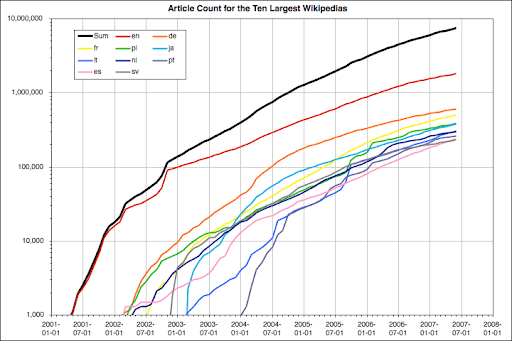
The growth of Wikipedia

http://en.wikipedia.org/wiki/Wikipedia:Size_of_Wikipedia

I love these graphs. That's all. An increase of 2,000 articles per day on Wikipedia. Even if you managed to read 3,000 articles per day, you'd spend 2 years just reading the current set, and in that time, Wikipedia would probably have doubled in size.


Labels:

Tuesday, September 02, 2008

Firefox vs. Chrome

I'm currently trying out the Chrome browser from Google. Very nice so far, however, pros and cons for each so far are:

Firefox:
Pros--
  • TwitterFox
  • Delicious
  • Ubiquity
  • ScribeFire
Cons--
  • Memory hog.

Chrome:
Pros--
  • Pretty (in a minimalist sort of way)
  • Fast
  • Relatively lightweight (in a 2008 application sense, not in an absolute program sense)
  • Special about: pages
Cons--
  • Looks like some Facebook functionality does not work. I think mostly involving Facebook apps.
  • Fails to render secure sites that are lost in the IE vs. Netscape 4.x days. Wouldn't be a huge downside if I didn't actually know of one that I use regularly.

Monday, September 01, 2008

Google browser officially to debut on Windows tomorrow

Google "launches" browser with a cartoon

It would seem to be a natural progression that if you're using Google services for 90% of your web usage (Google, Maps, Gmail, Blogger, Sites, Docs, ...) then a Google browser would make things run "even smoother."

This is something that Internet Explorer has had in a way for some time. ...and Firefox has 20% without being the default install in any set up (unless some Linux distros opt for Firefox over the native WM browser). 20% of web users made the choice to use Firefox. IE 6's share is 25%, so I would venture that that 25% did not *choose* IE. In fact, 0.13 percentage points of IE traffic is pre-6.0.

Google will have a much more effective platform through which to push their browser.

Labels:

Free tools article at Lifehacker

Free: Free Replacements for Paid Tools

I never really considered GParted as a replacement for PartitionMagic.

Labels:

Great article on life-hacker about Windows Performance tweak myths.

Mythbusting: Debunking Common Windows Performance Tweaking Myths

Registry cleaners, memory optimizers, and Vista settings... oh my.

Labels:

First pieces of code in PowerShell

new-object:
$sw = new-object System.IO.StreamWriter("c:\ts.txt")


get-member:
$sw | get-member -memberType methods


For some reason, this method of invoking object methods is reminiscent of both Ruby and Smalltalk for me.

Labels: